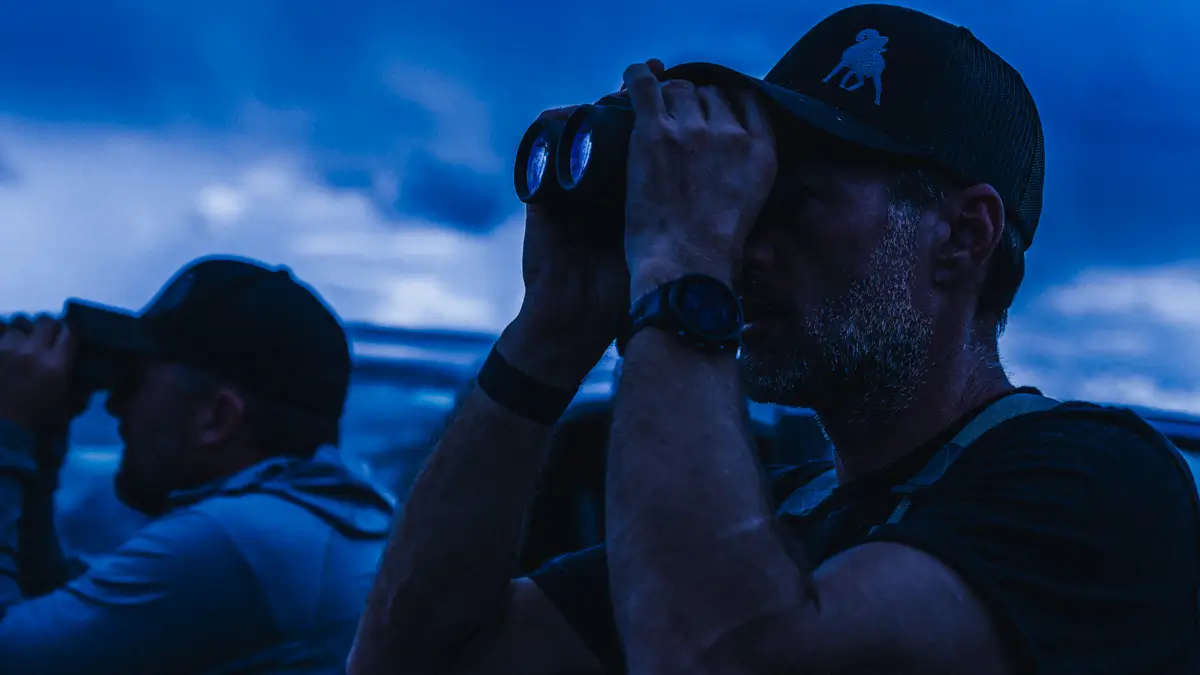
I’m sitting behind Swaro fifteens waiting for the sun to come up. It’s a quarter to six now, and the sun rises around 6:40 am this time in October. It’s still dark, but landscape features are starting to take shape. I’m looking for Coues deer with my dad.
At the edge of the binos I notice something moving. A blotch of dark gray against less dark gray that I’m assuming is yellow grass. I center my focus on the movement, and it’s gone. I move the binos back, and it’s there moving at the edge again. This time, I let my center vision rest on the movement, and eventually I see a small buck 900 yards away.
We call this time of day gray light. But it isn’t gray. It’s mostly blue, scattered light, and it’s building fast. Colorful reds and oranges build on the eastern horizon.
But until it builds, the working sensors in my eyes are the rods, not cones. Rods sit toward the outer edge of the eye and handle peripheral vision. They don’t register color, only brightness, which is why gray light looks gray even though it isn’t. Rods are also highly sensitive to movement, which is why I caught the deer at the edge of my binoculars.
Cones, on the other hand, register color and detail. They’re concentrated in the center of our vision, which is why I lost what I was looking at when I focused on it. And as the light built, the cones took over and I identified the buck.
In darkness and dim light, rods are crucial. They don’t come online in an instant. It takes 20 to 30 minutes for them to fully activate. And at any moment during that process, bright white light can send you back to the beginning.
This is why you hate it when your buddy looks at you with his headlamp on. He shines 500 lumens of 6000K blue-white light directly into your eyes, and your rods curl up like a roly-poly.
The first way to fix this is to change the light. Instead of the bright white light, use the red setting if your headlamp has one. You’ll lose some contrast, but the rods are less sensitive to red wavelengths, so you preserve some night vision.
Even better, move your headlamp from above your line of sight to below it. Josh did this while we were elk hunting last month, wearing it around his neck, resting on his beard.
And even better than that, hide the source. Josh’s lamp was lower, but the bulb was still in view. Glare comes from seeing the source. A bright point of light in your field of view constricts your pupils and hits your rods even when it isn’t aimed where you’re looking. The light that reflects off the trail is far dimmer than the bulb itself. Hide the bulb and your eyes only deal with the reflected light, so they stay open and adapted.
Do that on the hike in, and your rods will be ready when a Coues buck moves at the edge of your binos, 900 yards out in the gray light.
Appreciate Our Work?
You can support the content we're creating by simply buying us a beer. Staying hydrated keeps the content coming.
Click the image to send a small donation. Cheers!